
Before Santiago
The Cartagena Connection

In a couple of days, we’ll be taking a group of wine enthusiasts from Newcastle Wine School to Galicia.
Like most wine trips, the preparation has involved a familiar mix of spreadsheets, hotel confirmations, restaurant reservations, winery visits and last-minute logistics. There are rooming lists to finalise, coach companies to chase and inevitably a weather forecast to obsess over.
There has also been a fair amount of reading.
The enjoyable kind.
The sort of reading that starts with Albariño and somehow ends up two thousand years in the past.
As we’ve prepared the tour handbook, I’ve found myself spending evenings reading about Galicia’s history, pilgrimage routes and the story of Santiago de Compostela. It is impossible to explore Galicia for long without encountering St James. His image appears everywhere: on church façades, in guidebooks, on pilgrim passports and on the scallop shells that have become one of Europe’s most recognisable symbols.
Then, buried in one account of the saint’s journey through Hispania, I came across something unexpected.
Cartagena.
Not Santiago.
Not Galicia.
Cartagena, in the Region of Murcia.
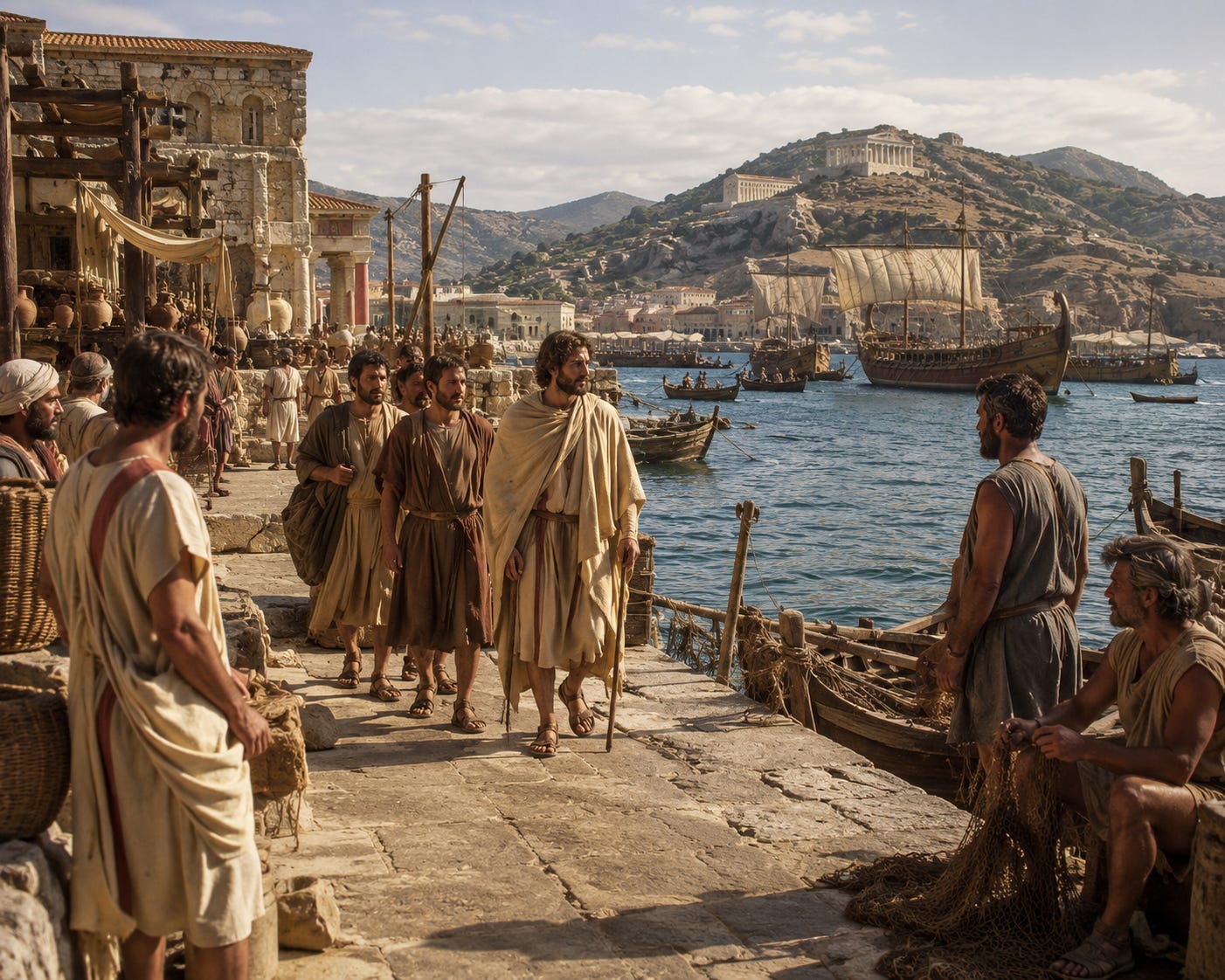
According to a long-standing Christian tradition, St James the Greater first arrived in Hispania through the Roman port of Carthago Nova, modern-day Cartagena.
One of the first disciples called by Jesus and traditionally regarded as a close relative of Christ, perhaps his cousin, James is said to have travelled west after the death and resurrection of Jesus to preach Christianity in the Iberian Peninsula. His journey supposedly began at Carthago Nova, then one of the most important ports in Roman Hispania and a gateway between the Mediterranean world and the interior of the peninsula.
Whether he actually set foot in Cartagena is impossible to prove and remains a matter of faith rather than established history. Yet the story endured. According to the same tradition, after James was martyred in Jerusalem around AD 44, his followers carried his remains back to Galicia, where they were eventually buried near what would become Santiago de Compostela.
In that telling, one of Europe’s greatest pilgrimage stories begins not in Galicia, but on the Mediterranean shores of Cartagena.
But what caught my attention was not whether it happened.
It was where the story led.
Cartagena is a place I know well. My eldest son married a Cartagenera, so over the years it has become part of our family story too. We spend a great deal of time there. It is a city that has become familiar through family visits, long lunches, walks along the waterfront and countless conversations about its history.
Yet somehow it took planning a wine tour to Galicia to start looking at it differently.
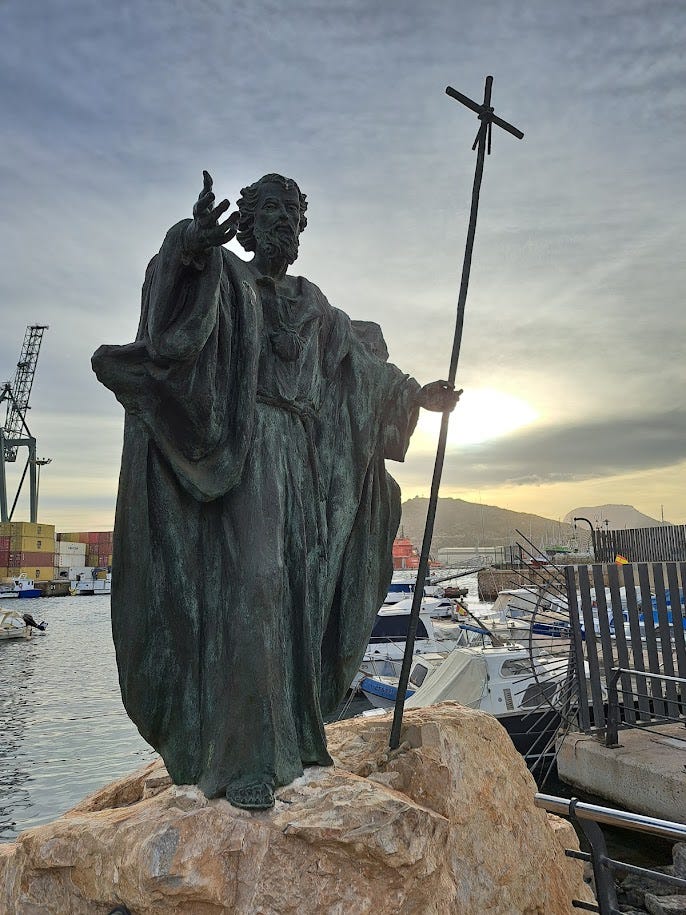
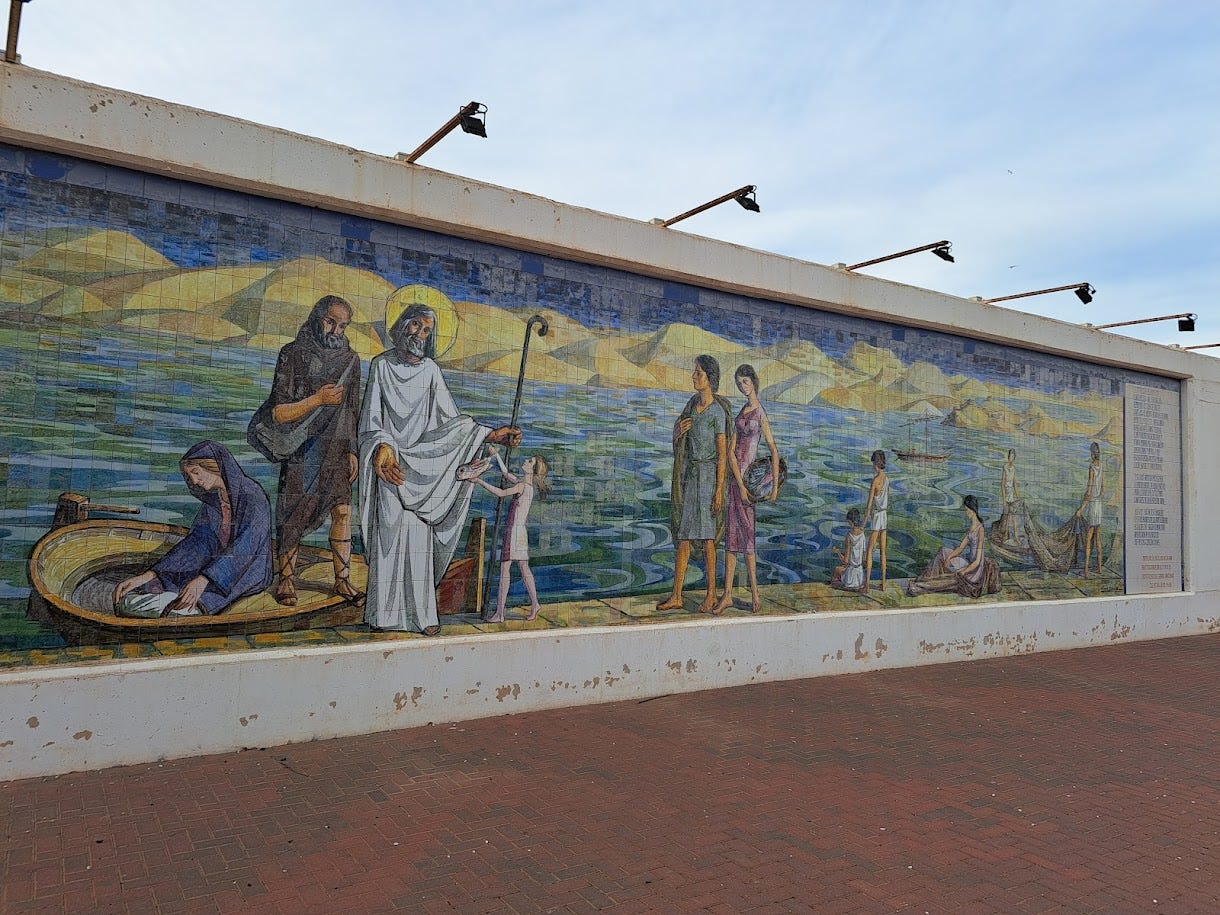
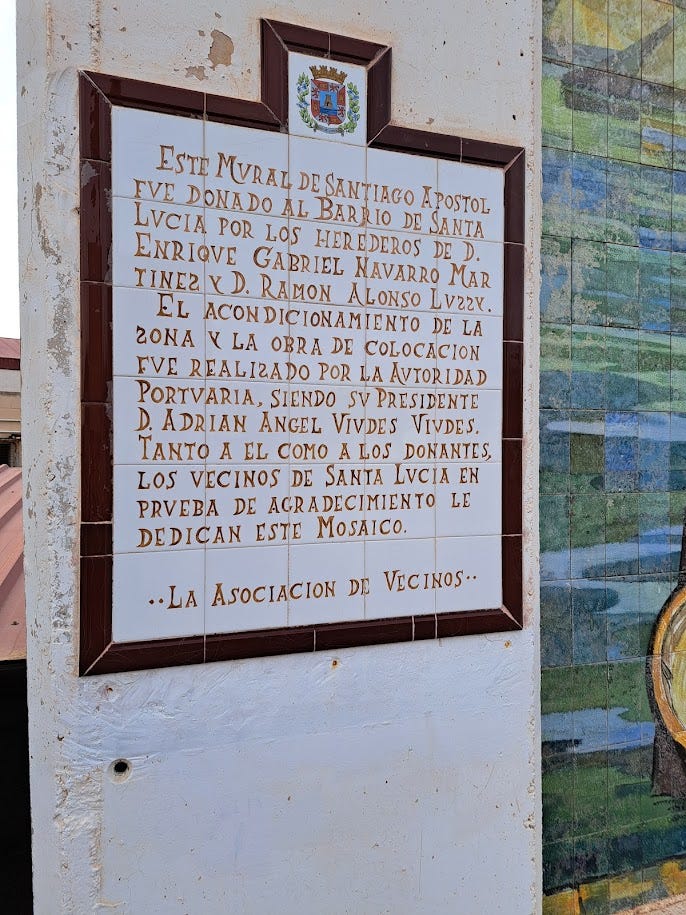
There is a statue of Santiago in the barrio of Santa Lucía. Standing beside the harbour, he appears almost to be coming ashore, as though the tradition of his arrival in Hispania had been captured in bronze. Nearby stands a white stone Cross of Caravaca, bringing together two pilgrimage traditions that I had always thought of as belonging to very different parts of Spain.
The symbolism is difficult to ignore.
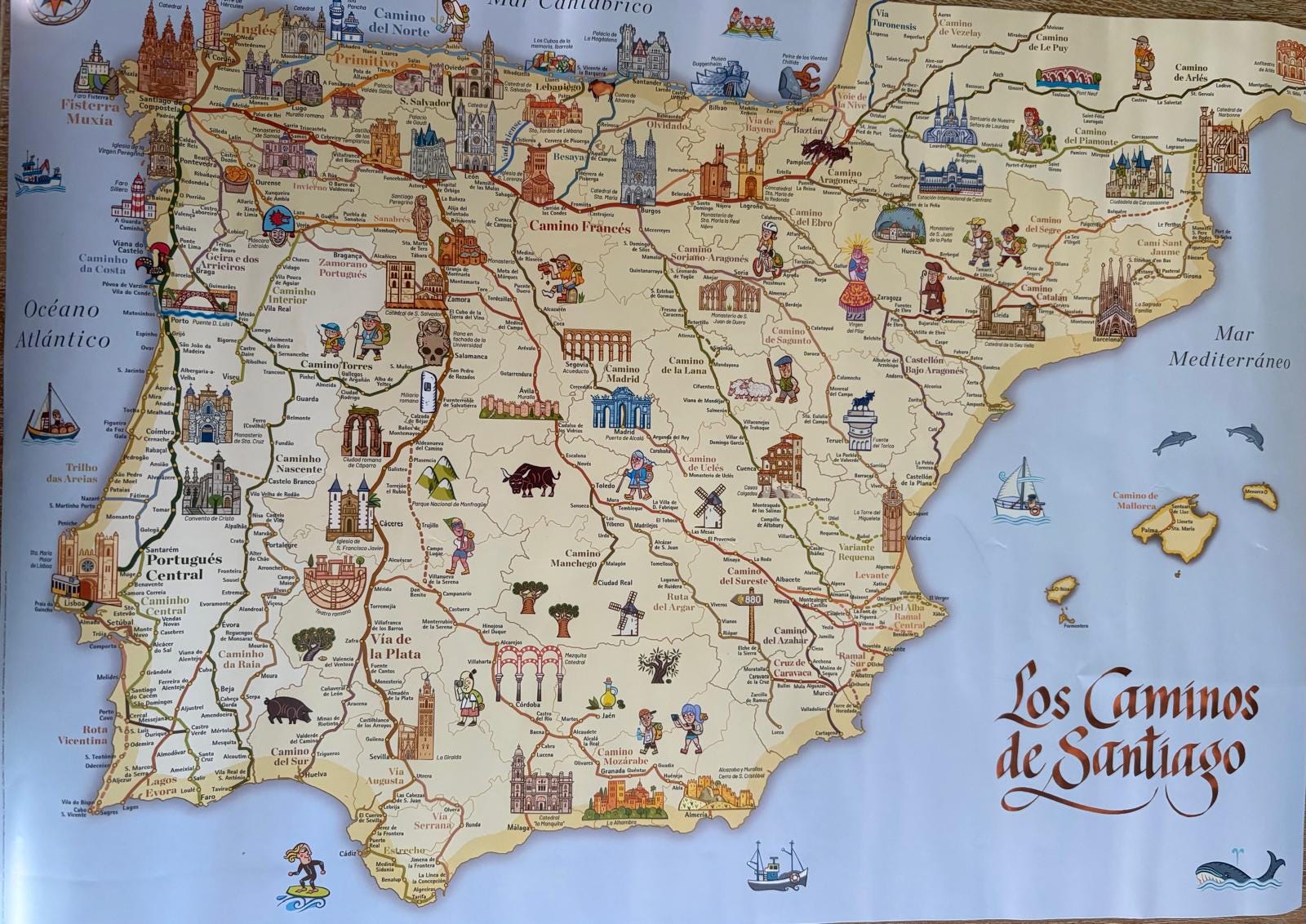
On one side stands Santiago, whose name is inseparable from Compostela and the great pilgrimage routes of northern Spain. On the other stands the Cross of Caravaca, drawing pilgrims towards the north-west of Murcia. Between them sits Cartagena, a city more often associated with Romans, naval history and the Mediterranean than pilgrimage.
Suddenly the scallop shells, the Cross of Santiago and the routes that criss-cross Spain no longer felt like distant Galician traditions. They were appearing much closer to home.
What struck me most was not the history itself, but the geography of it. I had walked past that corner of Cartagena many times without giving it much thought. After weeks spent reading about Galicia, it suddenly seemed to tell a completely different story.
Perhaps this is one of the reasons I am drawn to wine regions.
Wine encourages us to pay attention.
A vineyard is never just a vineyard. A bottle is rarely just a bottle.
You start by asking about a grape variety and end up discussing Roman trade routes. You visit a winery and discover a monastery. You learn about a local festival and find yourself reading about medieval pilgrims.
The best journeys tend to work like that.
They refuse to stay in their lane.
People may join a tour because they want to learn about Albariño or Mencía. Yet along the way they often discover something more. The landscapes that shaped those wines. The people who produce them. The stories that connect one region to another.
This latest discovery feels like a good example.
I set out to learn more about Galicia.
Instead, I found myself rediscovering a part of the Region of Murcia.
In a few days we will stand in Santiago de Compostela with a group of travellers from the north-east of England. Some will notice the cathedral. Some will notice the pilgrims arriving in the square. Some will notice the scallop shells embedded in the streets.
And I suspect I’ll be thinking about Cartagena.
About a Roman port on the Mediterranean.
About a story that may or may not be true.
And about how the most interesting journeys often begin much closer to home than we expect.
What a great read! I really need to get back to Cartagena soon. Loved the history here. Say hi to Galicia and Santiago for me.